
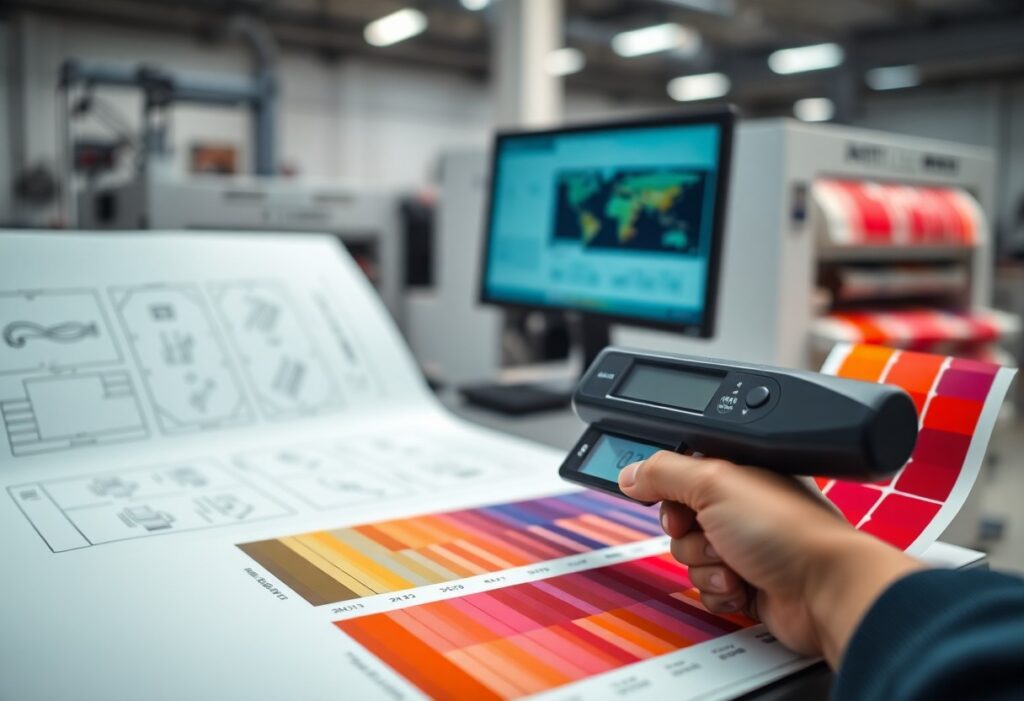
Many packaging projects fail at the final print stage due to overlooked proofing steps and poor color control. You can prevent expensive reprints by mastering prepress checks and maintaining consistent color standards across devices. A disciplined approach to proofing and calibration puts you in control of quality and brand accuracy.
The Geometry of Color
Color behaves differently across surfaces with folds, curves, and seams. You must anticipate how light interacts with these dimensional shifts to maintain visual consistency. A hue that looks uniform on a flat proof may appear uneven once wrapped around a corner.
Designing for three-dimensional packaging means treating color as a spatial element. Each angle changes perception, so your choices must account for real-world form, not just digital previews.
Light and Shadow on the Fold
Light catches edges and creates subtle gradients where panels meet. You’ll see shifts in tone that aren’t present in 2D mockups, especially with glossy finishes or metallic inks.
Shadowed creases can mute color, making adjacent areas seem mismatched. Test physical prototypes under multiple light sources to catch these variations before print runs begin.
Ink Density as a Moral Choice
Ink density affects more than appearance-it influences environmental impact. You control how much pigment goes onto each package, and over-saturation wastes resources and increases drying time.
Printing darker than necessary strains recycling processes and raises emissions. Choosing the minimum effective density reflects responsibility, not compromise.
Opting for lower ink density doesn’t mean sacrificing quality. Modern inks deliver rich color with less material, proving that sustainable choices can enhance efficiency. You set the standard every time you approve a proof-make it one that considers the full lifecycle of the package.
The Cost of the Wrong Red
Color missteps can derail a packaging launch before it begins. One brand learned this when their signature red appeared orange on shelf, triggering a costly recall.
Consumers recognize brands by color, and even a slight shift in red can break that connection. A single incorrect batch means wasted materials, delayed shipments, and damaged trust.
Waste in the Afternoon
Waste often piles up fast when colors don’t match. A beverage company once scrapped 10,000 units by mid-afternoon after discovering a red hue drifted from the approved standard.
That discarded run wasn’t just lost product-it was wasted time, energy, and labor. Once the press starts, errors multiply quickly without accurate proofs to guide it.
The Weight of Rework
Rework adds invisible weight to every project. Each round of corrections pulls teams off schedule, strains vendor relationships, and inflates production costs.
Correcting a single color error can require new plates, recalibrated presses, and additional QC checks. The ripple effect touches every department from design to logistics.
Fixing a color mismatch after printing begins often means halting the line, reprocessing materials, and rescheduling deliveries. These delays accumulate, turning a small oversight into days of lost momentum and added expense. Consistent proofing and calibrated color standards prevent these cascading setbacks before they start.
Tools for the Honest Printer
Every accurate print begins with tools that report color truthfully. Relying on guesswork or visual checks alone invites costly errors, especially in packaging where brand consistency is non-negotiable. You need instruments and software designed for precision, not convenience.
Trust grows when your process removes subjectivity. The right tools don’t flatter-they measure, compare, and confirm. For packaging printers, honesty in color means using technology that reflects reality, not perception.
Spectrophotometers and Precision
Color consistency starts with a spectrophotometer that captures exact spectral data. These devices eliminate guesswork by measuring reflected light across wavelengths, giving you objective values for every hue.
Your press runs smoother when spot colors and CMYK builds are verified before production. A handheld or inline spectrophotometer ensures every batch matches the approved standard, reducing waste and rework.
Software that Does Not Lie
Software becomes trustworthy when it reflects real-world color behavior. Tools with accurate ICC profiling and simulation engines show how colors will appear on final substrates, not just on screen.
You gain confidence when soft proofs align with physical output. Choose software calibrated to your specific workflow-ink, paper, and press conditions-so predictions match reality.
Reliable software integrates with your existing systems and updates profiles automatically when conditions change. It doesn’t assume; it calculates based on measured data, giving you a clear view of how colors will reproduce. This level of accuracy prevents last-minute surprises and keeps your clients satisfied.
To wrap up
On the whole, you ensure accurate packaging reproduction by prioritizing proofing and consistent color management. Skipping these steps risks costly reprints, brand inconsistency, and delayed time to market. You maintain control over output quality when you use standardized workflows, calibrated monitors, and physical proofs approved under proper lighting conditions.
Color errors often go unnoticed until final production, but you prevent them through proactive checks and clear communication with your print partners. Treating proofing as a non-negotiable phase protects your brand’s integrity and your budget.